
Hip flexor or groin pain from kicking: is it a strain?
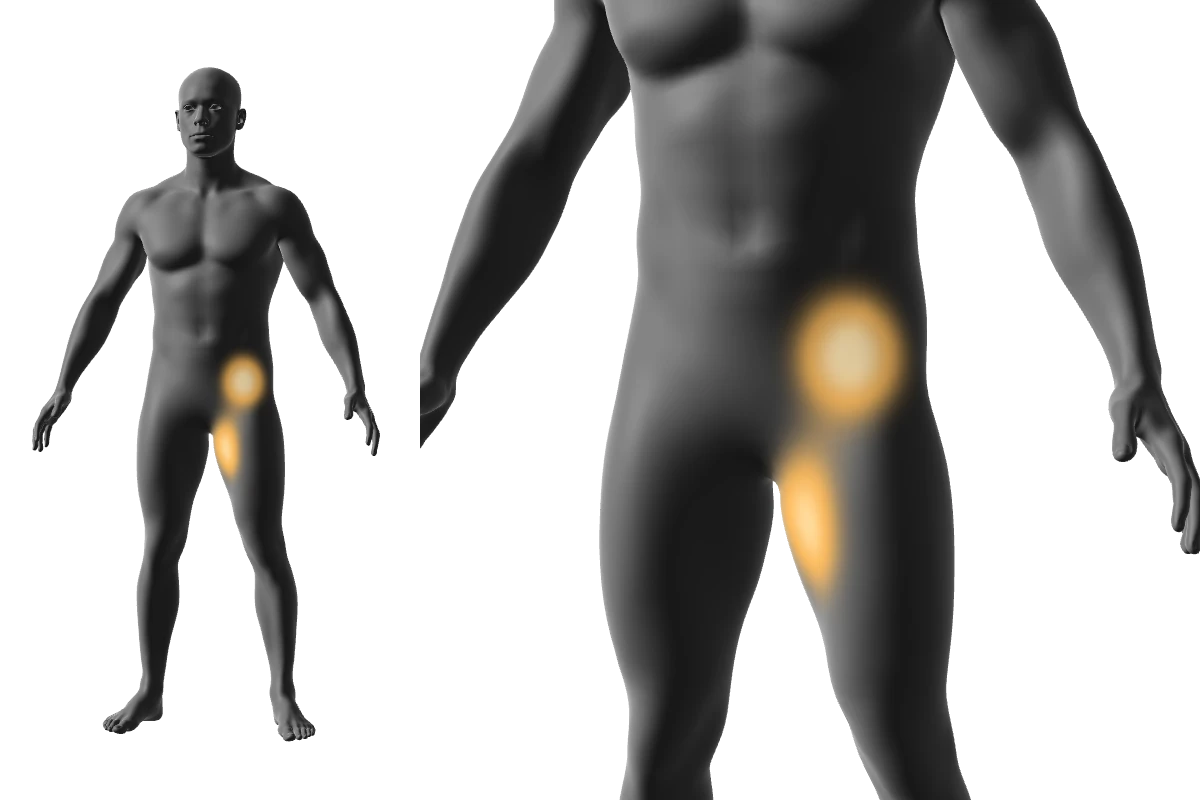
Sudden pain at the front of the hip or in the inner thigh during a kick or teep is usually a muscle strain: the hip flexor or groin (adductor) muscles stretched or torn past what they could handle. Most mild strains get better in a few weeks with relative rest and progressive strengthening. Deep groin pain that gets worse when you stand on the leg, or a hip that clicks, locks, or gives way, needs a closer look.
Why fighters get hip flexor and groin strains
Martial arts are one of the sports most linked to hip flexor strains. Strains happen when a muscle is stretched or loaded past what it can take, especially if you tense suddenly to brace for impact, skip your warm-up, or lack flexibility.
In Muay Thai, high kicks, teeps, and switch kicks take the hip flexors and groin through big, fast ranges.
Strains are graded 1 to 3. Grade 1 is minor damage that hasn’t torn through, grade 2 is a partial tear, and grade 3 is a full tear.
What to do in the first few days
- Stop kicking and anything that brings the pain on.
- Ice for 10 to 15 minutes, wrapped in a towel, every hour on the first day, then every 3 to 4 hours.
- Use compression shorts or a wrap, and keep the leg raised when you can.
- Use crutches if walking is painful.
- Over-the-counter anti-inflammatories can help, but don’t take them more than 10 days in a row without talking to a doctor.
How physical therapy helps
Your first visit is a 90-minute, one-on-one assessment: where it hurts, which muscle is involved, and how your hips, back, and kicking mechanics are working. Some groin pain isn’t a strain at all, so I also check for signs of a hip joint problem, a stress fracture, or a sports hernia, and refer you if needed.
Rehab is active and moves on milestones, not a set number of weeks. In a study of athletes with groin strains, a step-by-step program went from groin strengthening (including the Copenhagen adduction exercise), to running and change-of-direction work, to sport-specific drills including kicks. Athletes who passed all the pain-free checks before returning were re-injured far less often.
That research was in football players, not fighters, so I adapt it to kicking, teeps, and clinch work.
When can I train and spar again?
When you can do all of these without pain:
- Pressing on the muscle
- Squeezing your knees together hard, and a full inner-thigh stretch
- 10 Copenhagen adduction reps
- Sprints and quick changes of direction at full effort
- Kicks and teeps on pads at full speed, then sparring
See a doctor now if…
- You can’t move the leg or hip, or can’t walk or put weight on it.
- Deep groin or thigh pain that comes on when you stand or walk on the leg and doesn’t settle. This needs checking for a stress fracture of the hip, which may not show on early X-rays.
- Your hip clicks, locks, catches, or gives way. This can be a labral tear.
- Teenagers: sudden groin pain during a kick. In young athletes this can be a small fracture where the muscle pulls off the bone, which is often mistaken for a strain.
- Numbness, tingling, a cold feeling, or skin color change in the leg.
- A hot, swollen hip, fever, or feeling unwell.
Questions fighters ask
How long does a hip flexor or groin strain take to heal?
Mild hip flexor strains often feel better in a week or two. Mild to moderate groin strains usually take a month or two, and severe or repeated strains can take several months.
Can I prevent groin strains?
In a large trial of football players, one Copenhagen adduction exercise done 3 times a week in preseason and once a week in season lowered the risk of groin problems by about 41%. It hasn’t been studied in fighters.
Could it be a sports hernia?
A sports hernia causes groin pain that eases with rest and comes back with sport, especially twisting, and there’s no visible bulge. It’s more likely after repeated groin strains. Physical therapy often settles it, and surgery is considered if the pain keeps coming back.
I see fighters and active people one-on-one at Vital Force Muay Thai Gym in Chino, CA. Not sure what’s going on? Start with a free call.
Book a free discovery callSources
- Cleveland Clinic: Hip Flexor Strain: Symptoms, Treatment & Recovery
- Cleveland Clinic: Groin Strain: Causes, Symptoms, Tests & Treatments
- Serner et al.: Return to Sport After Criteria-Based Rehabilitation of Acute Adductor Injuries in Male Athletes: A Prospective Cohort Study (Orthop J Sports Med, 2020)
- Harøy et al.: The Adductor Strengthening Programme prevents groin problems among male football players: a cluster-randomised controlled trial (Br J Sports Med, 2019)
- Groh, Herrera: A comprehensive review of hip labral tears (Curr Rev Musculoskelet Med, 2009)
- Merck Manual Professional Edition: Stress Fractures
- Calderazzi et al.: Apophyseal avulsion fractures of the pelvis. A review (Acta Biomed, 2018)
- AAOS OrthoInfo: Sports Hernia (Athletic Pubalgia)
This page is general information, not a diagnosis. See the website disclaimer.